
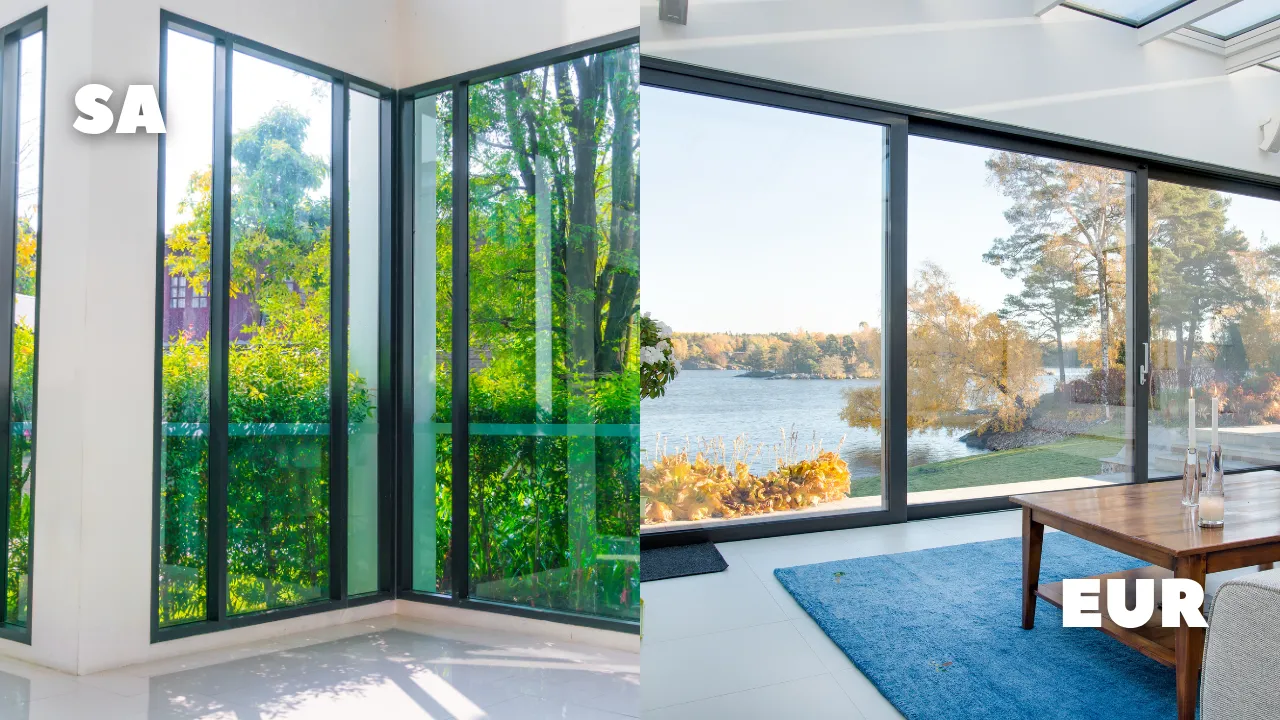
European-Style Aluminium Windows vs South African Standard Profiles: An Honest Comparison
If you are renovating or building, you will eventually face a choice between European-style aluminium windows and the standard South African aluminium profiles most homes are fitted with. It is easy to be told the European option is simply “better” — but that is not an honest answer. This guide compares European vs South African aluminium windows the way Alu-Decor’s Managing Director, Chris Slabbert, walks clients through it: what genuinely differs, when each is the right choice, and the one question that settles most decisions.
European vs standard South African aluminium: what's actually different?
The honest difference comes down to engineering intent. South African aluminium profiles were designed primarily around cost — to give the market an affordable, functional product that works in our climate and does the job well. There is nothing wrong with that; it is simply the starting point. European profiles were engineered the other way round, around performance: thermal efficiency, acoustic reduction, security, longevity and aesthetics.
Chris Slabbert puts it plainly — you are essentially comparing a reliable workhorse to a precision instrument. Both have a place. They simply answer different questions. The mistake is to treat one as good and the other as bad, when the real task is matching the right system to the right project.
The three differences you can see and feel
When Chris walks a client through both options, three differences come up first — and you can see and feel all three by handling a section of each profile:
- Profile depth and wall thickness. European profiles are noticeably more substantial. Hold a section of each and the difference is immediate.
- The sealing system. European windows use compression gaskets and multi-chamber designs that form a proper barrier against wind, water and dust. Local profiles typically use brush seals or basic rubber — adequate, but not comparable.
- The hardware. European systems use multi-point locking as standard, so the window locks at several points along its height rather than at a single central point. That alone reshapes the conversation around security and structural integrity.
Performance compared: thermal, sealing, security and durability
Thermal performance and thermal breaks
Thermal performance is where the gap is widest. European profiles use a thermal break — a non-conductive barrier inside the profile that separates the inner and outer faces — which sharply reduces heat transfer. In a Highveld summer or a Cape winter, that means real comfort and real energy savings. Standard SA profiles are typically mono-material, with no break, so the aluminium conducts heat and cold directly. In mild climates that is fine; in extreme temperature ranges you feel it. This also matters for compliance: South Africa’s National Building Regulations include energy-efficiency requirements for windows and glazing under SANS 10400-XA, so thermal performance is not just a comfort question — it is part of how a building is signed off.
Sealing and weather resistance
European systems are engineered for much lower air and water infiltration. The gasket design, the number of sealing points and the compression achieved when the window closes all add up to a quieter, drier, more airtight interior. If you are near a busy road or in a high-rainfall area, that is a functional benefit rather than a luxury.
Security and multi-point locking
On security, multi-point locking is standard on European systems. A local profile with a single central lock is easier to compromise than a window that locks simultaneously at the top, middle and bottom of the frame. Industry sources describe multi-point locking as providing distributed force resistance — because the locking points are spread around the frame, the sash is far harder to lever open. It is worth noting that multi-point locking can be specified on quality local systems too; on European systems it is simply the baseline.
Durability over time
European profiles tend to hold their dimensional accuracy better over the years — they resist warping, maintain their seal, and the hardware is engineered for a much higher cycle count. A well-installed standard SA aluminium window with good powder coating should still hold up solidly for fifteen to twenty years in normal residential conditions. Where local systems show their age first is in the sealing and the hardware: single-point locks wear, brush seals compress and lose effectiveness, and air and water infiltration slowly increases.
When European-style is the right choice
European-style aluminium is genuinely the right answer for a specific kind of project and client:
- Homeowners who value longevity over upfront cost, and who are building once without wanting to revisit the decision in ten years.
- Architects and developers specifying for homes that must perform at a defined level over decades — not just look good on completion day.
- Projects in areas with extreme temperature variation, high wind exposure or significant noise pollution.
- High-end residential, luxury developments, energy-conscious builds and passive-house designs.
Chris adds one observation from experience: almost any client who has lived with well-engineered European windows before — through travel or a previous home — does not want to go back. Once you have used a properly sealed window, you notice what you had before.
When standard South African aluminium is the smarter choice
This is the section most premium suppliers leave out — and leaving it out is a positioning play, not an honest assessment. Standard SA aluminium is the sensible, appropriate choice more often than the premium space likes to admit. If you are renovating a rental property, building a budget-conscious home in a mild climate, or working on a project where the returns simply do not justify the premium spend, local aluminium is an honest answer.
There is real value in the local product. It has been proven in South African conditions for decades, it is easier to source, faster to fabricate, and simpler to maintain — and when it is installed well, it does exactly what it is supposed to do. The South African industry has also improved markedly: extrusion quality, hardware options and finishing have all come a long way. Dismissing local aluminium as “inferior” is neither fair nor accurate. It is the right product for a large part of the market, and there is no shame in choosing it.
The practical realities: lead times, installation and parts
Three practical points are worth weighing before you commit, beyond performance on paper:
- Lead times. Local SA profiles are widely stocked and fabrication is fast, so a standard project can move quickly. European systems can carry longer lead times, particularly when specific hardware or components are imported. On a tight building programme, that matters — though good planning from the start usually softens it.
- Installation. European systems are less forgiving to install. The tolerances are tighter and the methodology is more exacting, so they need experienced installers who understand the product. Get the installation wrong and you lose the performance you paid for — which is why in-house, properly trained installation matters.
- Parts and support. Hardware on European systems can be more specialised, and parts availability depends on the supplier relationship behind the product. This is a fair question to ask any supplier of a European system: who is the local importer, what parts are held, and what happens if there is a problem in year eight? Alu-Decor is deliberate about which European systems it carries for exactly this reason — a window is only as dependable as the supply chain standing behind it.
How to decide: the questions worth asking yourself
When a client is genuinely torn, Chris does not start with the product — he starts with one question: how long do you plan to live in this house? That single question reframes everything. If you are planning to be there for twenty years, a premium product stops looking like a cost and starts looking like an investment spread across two decades. If you are renovating to sell within three years, the equation is different, and an honest adviser will tell you so.
A premium spent today feels very different when you break it down over the full life of the home rather than viewing it as a single lump sum — that shift in time horizon is what changes most people’s thinking. The second question is just as useful: what will bother you more — the upfront cost, or the regret of not doing it properly when you had the chance? Most people already know their own answer.
Frequently asked questions
Are European aluminium windows worth the extra cost?
For the right project, yes. The premium buys better thermal performance, superior sealing, multi-point locking and a longer performance life. Whether it is worth it depends on how long you will live in the home and how much the performance gap matters for the way you use the space. For a build-to-last home in a demanding climate, it makes sound sense. For a short-term renovation in a mild climate, it may not.
Is South African aluminium poor quality?
No. Standard South African aluminium is a legitimate, well-proven product that has performed across hundreds of thousands of homes, and the local industry has improved considerably in extrusion, hardware and finishing. It is engineered around cost and practicality rather than maximum performance — a different answer to a different question, not an inferior one.
Do European-style windows take longer to install?
They can. European systems often carry longer lead times, especially when hardware is imported, and installation is more exacting. Neither is usually a problem when the project is planned properly from the start — but both are worth factoring into a tight building programme.
Can standard aluminium profiles take double glazing?
It depends on the profile. European profiles are typically designed with a glazing rebate deep enough for thicker double or triple glazing units. Older South African profiles were often dimensioned for single glazing and may need adapting. If double glazing is important to you, confirm the glazing capacity of the specific profile before you commit.
Find the right aluminium system for your project
The honest takeaway is that there is no single right answer. European-style aluminium and standard South African aluminium are both good outcomes when the reasoning behind the choice is sound — it comes down to your time horizon, your climate, your budget and what you need the windows to do. The value of working with a team that installs both is that the advice is not tied to selling one system.
Alu-Decor has manufactured and installed aluminium and glass systems across Gauteng for more than 15 years, with in-house design, measurement, manufacture and installation, and is a member of SAGGA and AAAMSA. Take a closer look at the European-style aluminium windows and doors Alu-Decor installs, read the companion guide to tilt and turn windows, or talk to Alu-Decor about the right system for your project.